Practical, easy-to-understand welding guidance, real-world examples, and tools to help improve weld quality, productivity, and compliance. For welding professionals including welders, supervisors, inspectors, engineers, and business owners.
Stainless Steel Welding - Special Considerations
|
Trouble with text or images? View this in your web browser Hello Reader Stainless steel can be challenging to weld. Especially if most of your experience in welding has been with carbon steel. Stainless steels possess many properties that make them different from those of carbon steels. These differences provide certain advantages, such as corrosion resistance, but we must be aware of some of the intricacies of welding stainless steel to avoid problems. Many welding professionals, including welding engineers, that have worked primarily with carbon steels develop welding procedures for stainless steels without considering the properties below. This can lead to many problems. Properties of special interest are:
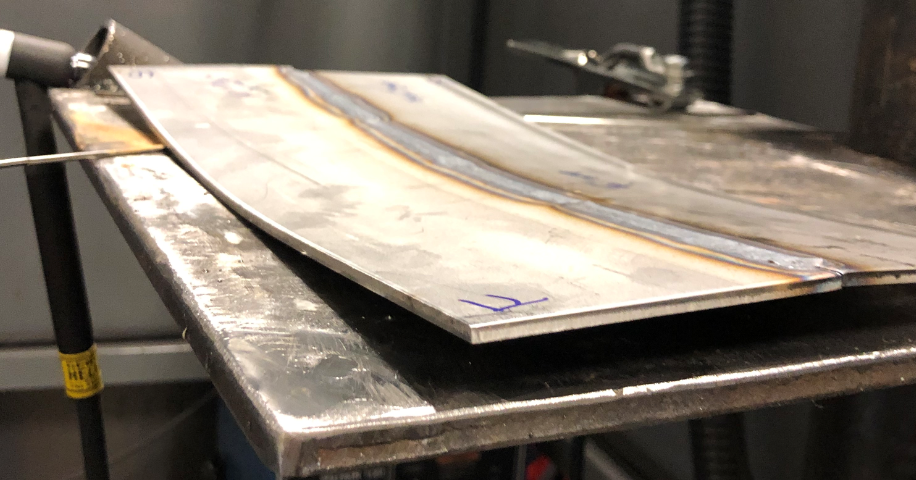
Thermal conductivity of stainless steels is much lower than that of carbon steels. This makes stainless steels very susceptible to local overheating and distortion when welded. Special attention must be paid to the heat input generated by the welding procedure used. Distortion and buckling is very common when welding stainless steel, especially thinner gauges. Minimizing the weld size and keeping heat input as low as possible can help mitigate these problems.
Thermal expansion is higher in stainless steel than carbon steels. This also facilitates distortions due to the larger increase and decrease in volume due to the heating and cooling cycle introduced by the welding process. Additionally, this higher thermal expansion produces higher residual stresses on welds during cooling. It is important to be aware of this especially when welding stainless to carbon steel. Using a 309 filler metal is always recommended, primarily because it prevents cracking that can occur due to the significantly different coefficients of thermal expansion.
Corrosion resistance is much higher in stainless steels than carbon steels. This corrosion resistance is aided by the high levels of chromium and nickel. The welding process can affect this corrosion resistance. If high heat inputs are used which result in slow cooling rates a situation called sensitization may occur. This can lead to cracking in the sensitized zone. Oxidation resistance is important because it facilitates cutting by oxy-acetylene. Because stainless steels resist oxidation until heated to temperature near or above their melting point in the presence of air, it requires the use of plasma cutting, laser, waterjet or other cutting processes. Do not attempt to cut stainless with the oxy fuel cutting process. Hardenability is usually something that we care about in carbon steels. After all, high carbon content is the main driver for hardenability. However, martensitic stainless steels have very high hardenability. This can result in embrittlement with the heating and cooling cycle of the welding process. As you can see, these characteristics of stainless steel force us to be very careful when developing welding procedures. Assuming it welds similar to carbon steel is a big mistake that can lead to problems such as premature corrosion, distortion and cracking. It is imperative to understand that stainless steel and carbon steel are completely different. We must always approach welding procedure development with a sound understanding of the physical and mechanical properties of the base metal we are welding. Have you had any issues with welding stainless steel? Do you struggle with distortion or premature corrosion? Do you have any questions regarding stainless steel? Send us a reply and let us know. |
Welding Answers
Practical, easy-to-understand welding guidance, real-world examples, and tools to help improve weld quality, productivity, and compliance. For welding professionals including welders, supervisors, inspectors, engineers, and business owners.
Trouble with text or images? View this article on your web browser Hello Reader Galvanized steel is widely used in metal fabrication because of its excellent corrosion resistance. From structural steel components and handrails to trailers, agricultural equipment, and outdoor structures, galvanizing provides a relatively inexpensive way to protect steel from corrosion and extend its service life. However, welding galvanized steel presents challenges that are not encountered when welding...
Trouble with text or images? View this article on your web browser. Hello Reader Competition among welding equipment manufacturers is a great thing. Companies such as Miller, Fronius, OTC, Lincoln Electric, and others continue to develop welding machines that are more capable, easier to use, and increasingly affordable. Welders and manufacturers have benefited tremendously from these advancements. However, there is a potential downside: the belief that better welding equipment is the answer...
Trouble with text or images? View this article on your web browser Hello Reader Few welding discontinuities create more concern than cracks. Unlike porosity, undercut, or excessive reinforcement, cracks are almost never acceptable under structural welding codes because they can significantly reduce the strength and reliability of a welded joint. More importantly, cracks tend to propagate under service loads, meaning a small crack can eventually become a catastrophic failure. Understanding why...